
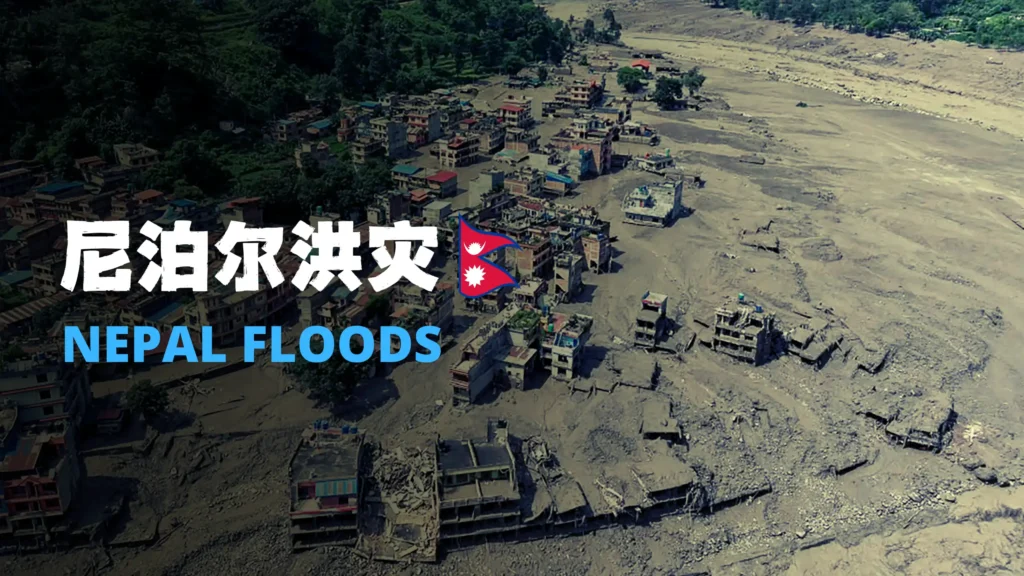
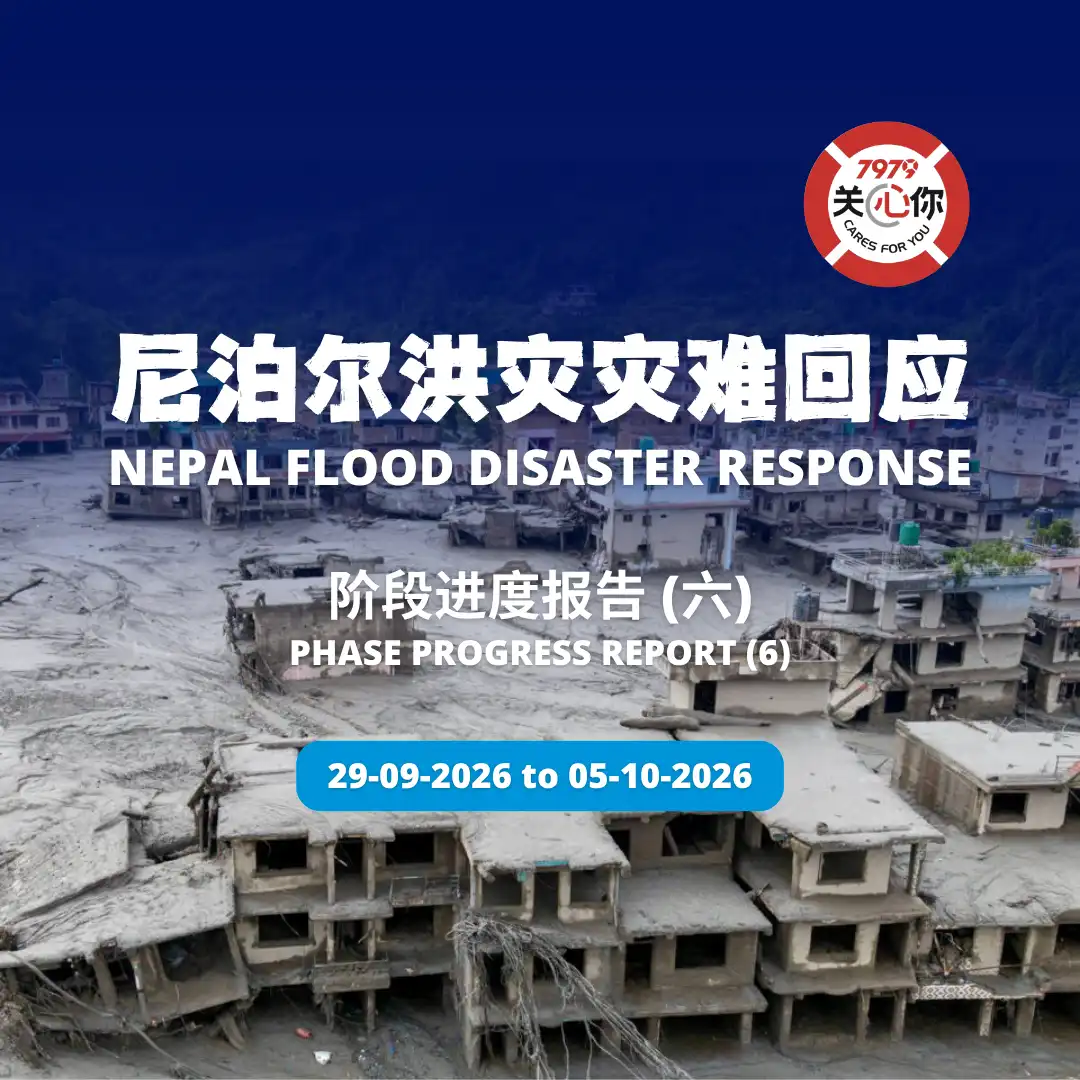
尼泊尔洪灾灾难回应 · 阶段进度报告(六)
进入第二阶段:家庭卫生包与保暖物资
一、本期概览
这一周,救援的重点从“有没有物资”转向“家庭现在最需要什么”。MCDS 与 NBCC 检视第一阶段成果后,把方向转向家庭卫生、保暖、返校与心理社会支持;本期先行落地的是家庭卫生包和棉被/毛毯。Eddy 在现场协助 MCDS 完成整备与发放后,已于10月初返回。
| RM 126,619.67 7979 累计收到善款(截至10月15日) | 800 套 家庭卫生包整备总量 | 650 套 已确认发放(10/1–10/3,共 9 处) | 25户 · 89人 Pipaltar 的 MCDS支持帐篷营地 |
备注:
- 善款已超出原定目标。 原定目标 RM 70,000,目前已收到 RM 126,619.67,超出 RM 56,619.67(约达成 181%)。感谢每一位支持的弟兄姐妹、教会与伙伴。
- 800 套是整备量,已确认发放 650 套(约 81%):10月1日 314 套(五处)、10月2日 186 套(三处)、10月3日 150 户(Mandredhung,一处)。10月3日是户数,按每户一套推算。
- 棉被/毛毯原计划 500 条,10月2日、3日共三处的发放中包含了棉被或毛毯,但各处都没有条数记录,总数待 MCDS 确认,本期不写。
二、灾情与现场:安置点里的生活
2.1 受灾家庭的新情况
随着部分道路逐渐恢复,MCDS 与当地伙伴得以进入更多社区,发现一些家庭暂住在当地人家中,不在集中安置点内,较难通过安置点渠道获得援助。当地政府的社区负责人已带领团队逐户探访,让这些家庭也被看见、被支持。
近期尼泊尔天气恶劣,部分前往灾区的行动需要暂缓,团队按天气与路况安排后续援助。另外,9月29日 Eddy 提到加德满都谷地的 Lalitpur 附近又有山体滑坡,社交媒体上也有西北部 Mustang 的滑坡视频;两处均离 MCDS 的工作区域较远,未列入本次回应范围,但提醒我们山区地质仍不稳定。
2.2 Bada Choudara 临时安置营:照片里看到的
这是本期发放量最大的安置点。Eddy 9月30日晚抵达 Bidur 后回报:营地所在位置属宗教场所,与当地居民存在土地争议,官方正用铁皮(CGI)搭建临时屋,约 46 间,每间供一户居住。以下这组照片都是 Eddy 在这个营地发回的,从中可以看到:
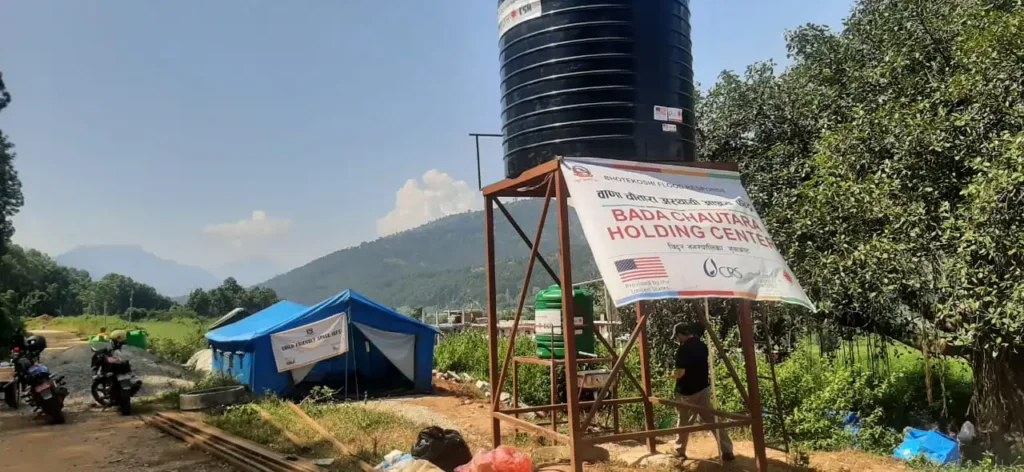
营地标牌:Bada Chautara Holding Center(Bidur 市),含“Bhotekoshi Flood Response”字样 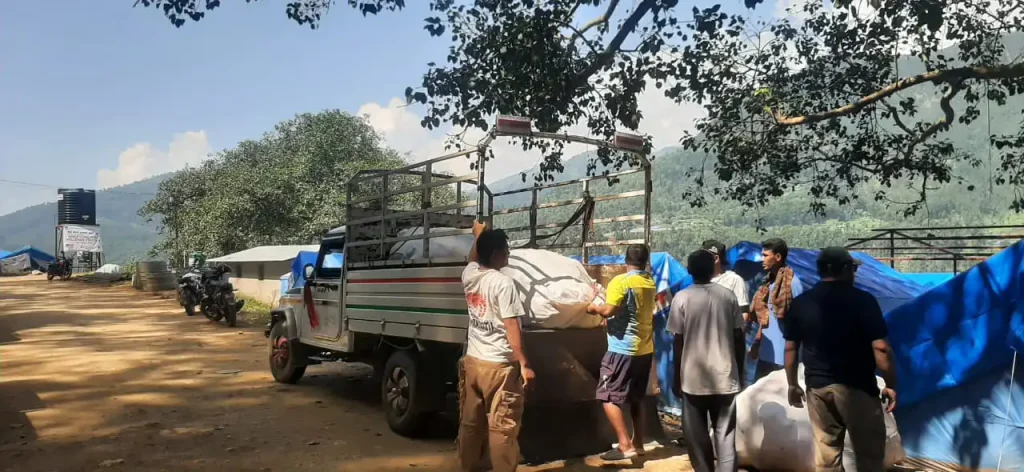
皮卡车正在卸运物资;左后方可见标牌与蓝色大水箱 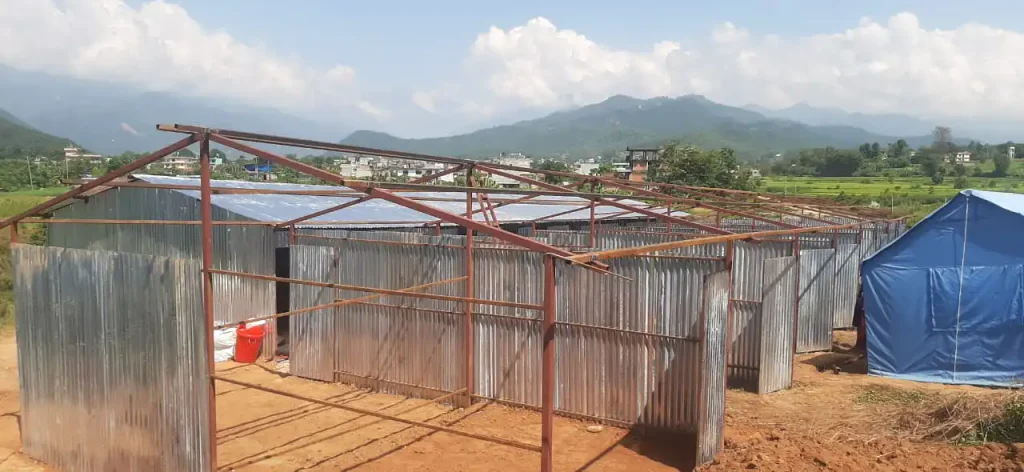
铁皮临时屋:钢架与墙板已立好,屋顶尚未完成 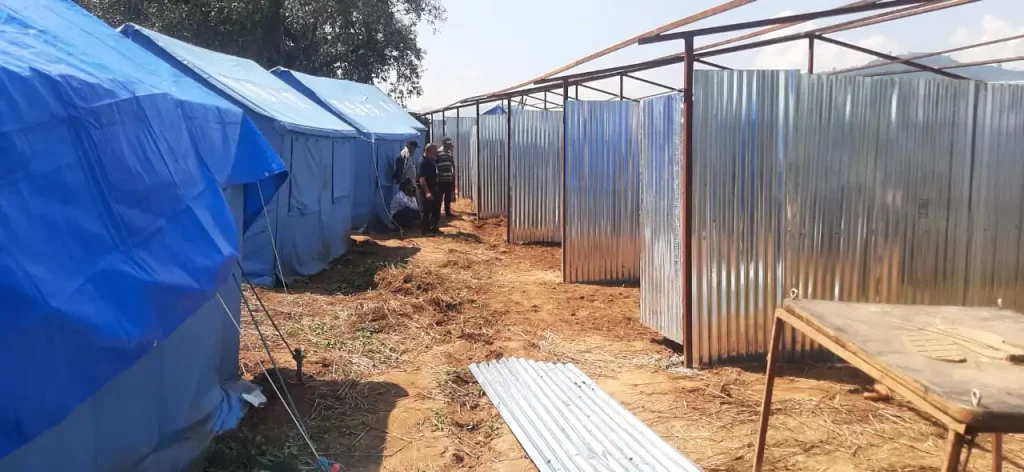
一排排隔间式铁皮屋(右侧仍是帆布帐篷)
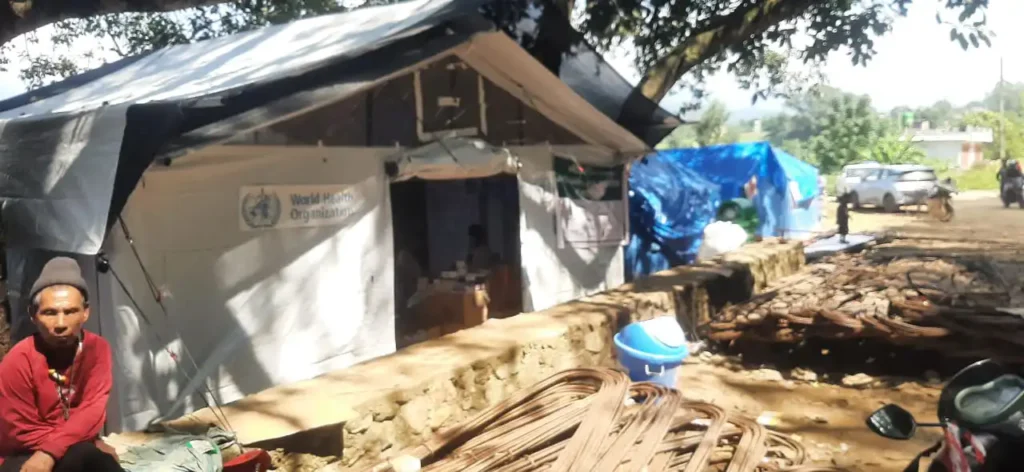
WHO 医疗帐篷,内有药品箱;前方堆放建材钢筋
- 设施已有一定基础:营地有大水箱、儿童友善空间(Child Friendly Space)帐篷和 WHO 医疗帐篷,说明饮水、儿童与基本医疗已有人负责。
- 住房仍在过渡中:铁皮屋只见墙架、未见完整屋顶,旁边的家庭仍住在蓝色帆布帐篷里。我们无法从照片判断完工时间,需向 MCDS 取得进度。
- 运输靠人力与小货车:卸货现场没有大型车辆,物资最后一段仍靠皮卡与人工搬运,这也是整备与发放必须配合路况安排的原因。
三、MCDS 做了什么
3.1 第二阶段的方向
MCDS 与 NBCC 检视救援进展后,把重点逐步转向:儿童返校用品、冬季及保暖用品、家庭卫生及妇女卫生用品、心理社会支持。目前同步准备 800 套家庭卫生包及 500 条毛毯。
3.2 家庭卫生包:每户一套,共 19 项
MCDS 以 UNFPA 的清单为参考,拟定每个家庭一套的内容,全部装入一个手提袋。每套成本约 NPR 2,500,零售价约 NPR 3,500,自行整备比零售便宜约 NPR 1,000(约 29%)。按此估算,800 套的整备成本约 NPR 2,000,000,已发放的 650 套约 NPR 1,625,000(均为估算值,以 MCDS 正式账目为准)。
| 类别 | 内容(每户一套) |
|---|---|
| 个人清洁(7项) | 牙刷 4 支、牙膏 1 支、洗发水 1 瓶、沐浴皂 2 块、小毛巾 1 条、洗手液 1 瓶、塑料水杯 1 个 |
| 衣物与洗涤(3项) | 洗衣皂 2 块、内裤 4 件(男 2、女 2)、袜子 3 双/组(男、女、儿童) |
| 妇女与日常护理(6项) | 卫生巾 1 包、梳子 1 把、指甲钳 1 个、剃须刀 1 支、棉签 1 包、创可贴 1 包 |
| 其他(3项) | 卫生纸 1 卷、垃圾袋 1 包、手提袋 1 个(用来装全部物品) |
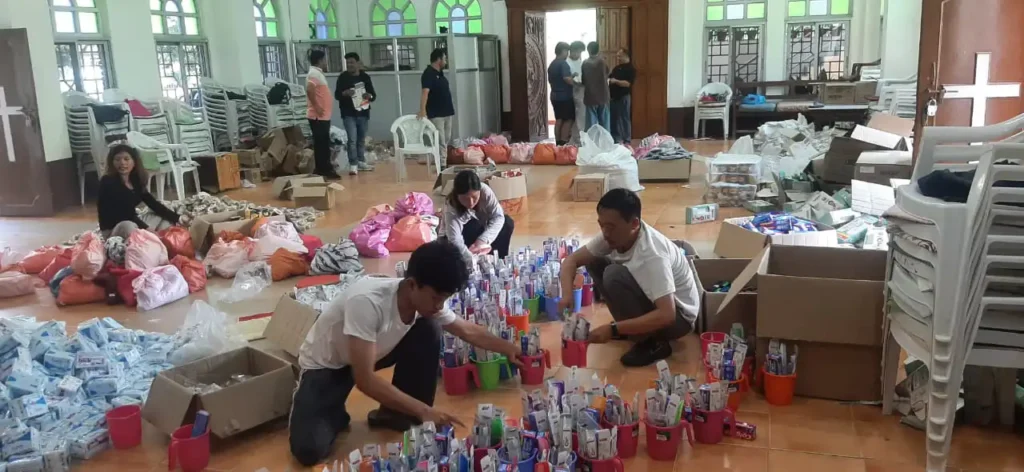
9月30日:志工在教会礼堂内分装卫生包——塑料杯里插着牙刷、牙膏,地上排满待装的手提袋与洗涤用品
3.3 发放总览:三天、九处
以下是 Eddy 回传的 10月1日手写记录、10月2日文字记录(10月8日补发)和 10月3日补报。“套”指家庭卫生包;棉被/毛毯一栏只记录有无,条数均未记录。
| 日期 | 发放地点 | 卫生包(套) | 棉被/毛毯 |
|---|---|---|---|
| 10月1日 | Bada Choudara 营地 | 144 | – |
| Pipaltar Ward 5 India Red Cross Camp | 70 | – | |
| Thilagaun Holding Center | 48 | – | |
| Lito Holding Centre | 27 | – | |
| Ward 5 MCDS Camp(Shree Chandra Jyoti 中学旁) | 25 | – | |
| 10月1日小计 | 314 | ||
| 10月2日 | Save the Children camp(Transitional Shelter Camp) | 45 | 有(纤维填充毛毯) |
| Kashita | 104 | – | |
| Majhigaun | 37 | 有 | |
| 10月2日小计 | 186 | ||
| 10月3日 | Bidur Ward 6,Mandredhung | 150(户) | 有(棉被) |
| 已确认累计 | 650 | 占整备量 800 套的 81% |
说明:10月2日的 “45 sets plus fibre filled blanket”“37 Hygiene kits plus Blankets” 理解为卫生包加毛毯;10月3日 150 户按每户一套卫生包推算。整备量余下约 150 套。
| 现场回响: Eddy 10月2日回报,连续两天发放家庭卫生包后,受灾家庭——特别是妇女——非常高兴,尤其是收到洗发水,有人在发放还没结束时就去洗头。他建议 MCDS 继续做家庭卫生包。 |
3.4 各发放点的照片与观察
(一)Bada Choudara 营地|10月1日 144 套
以下四张发放照片拍摄于 Bada Choudara 营地(Eddy 回传照片时注明):
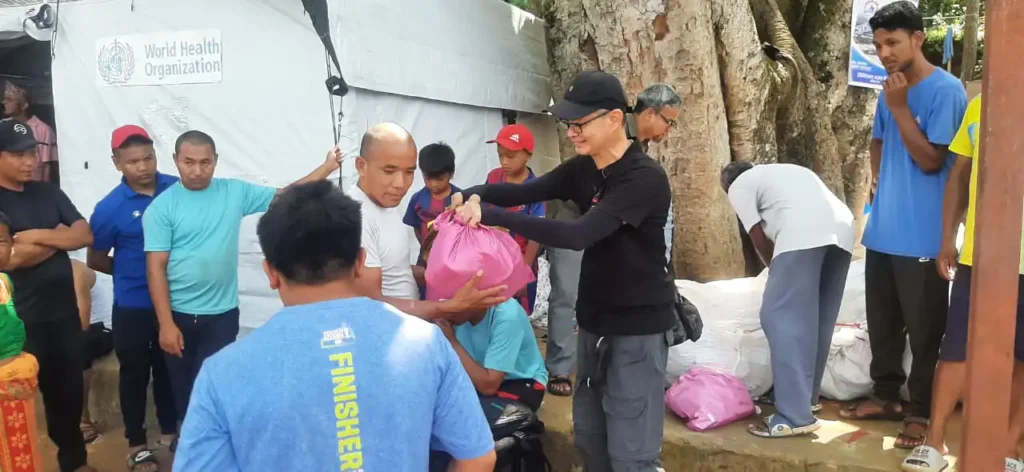
在 WHO 帐篷旁的发放:Eddy把粉红色手提袋交给受灾居民 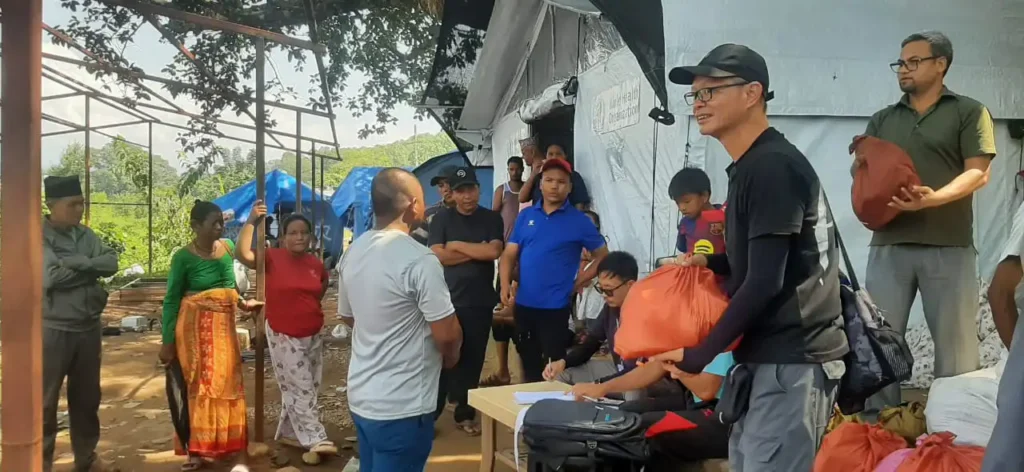
登记桌(画面下方)有人逐笔记录,居民围在一旁等候领取 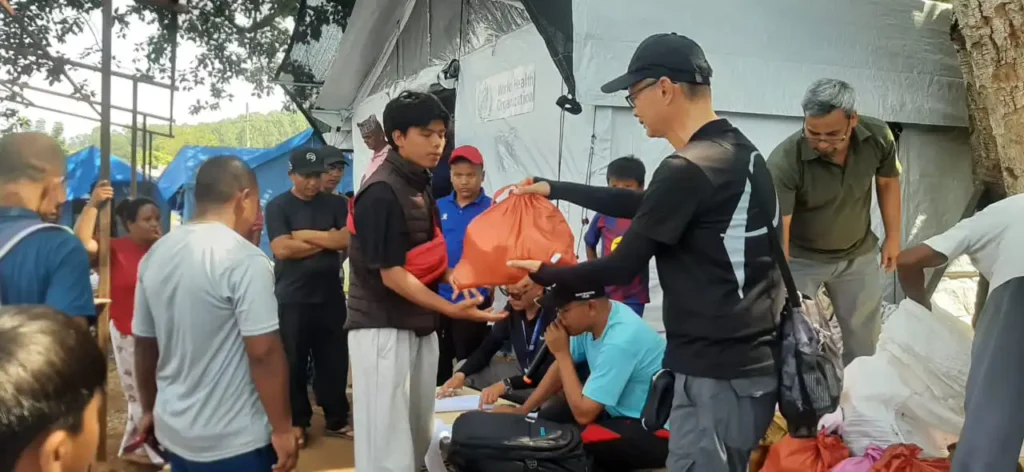
年轻居民领取橙色手提袋 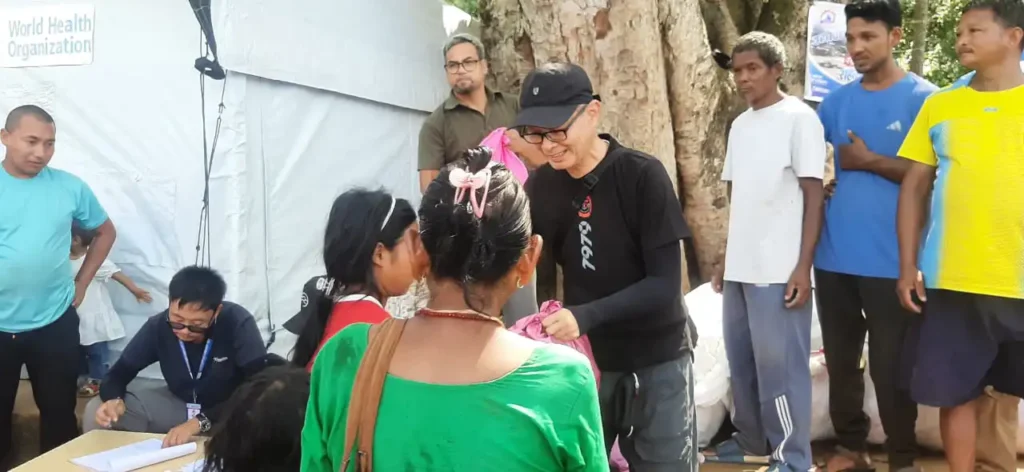
Eddy(黑色 7979 上衣)把卫生包交给一位妇女;左下方仍有人在填写登记表
- 有登记、有秩序:几张照片都能看到登记桌、纸本表格和佩戴工作证的登记人员,居民站着等候,这是日后核对名单与数量的基础。
- 对象是家庭:领取者男女都有,孩子也在场;一套包内含男女内衣、卫生巾与儿童袜子,是按“一家人”设计的。
- 当地人员一同参与:画面中除了Eddy,还有多位当地人员在场协助搬运与登记,不是外来团队单独完成。
(二)India Red Cross Camp|Pipaltar Ward 5|10月1日 70 套
标牌写的是 Temporary Shelter Camp(临时住所营地),尼泊尔文注明为“Rasuwa 洪灾流离失所者”而设,地址 Pipaltar‑Bidur 05, Nuwakot;下方标识依次是 Nepal Red Cross Society(Nuwakot 分会)、People in Need 和 Bidur 市政府。
- Eddy 记录的名称是 “India Red Cross Camp”,标牌上写的是 Nepal Red Cross,两者的关系待确认。
- 这是一个由红十字会、国际机构与政府共同管理的营地,MCDS 在其中负责这批卫生包的发放。
- 营地有带红十字标识的绿色大水箱,水源有保障。
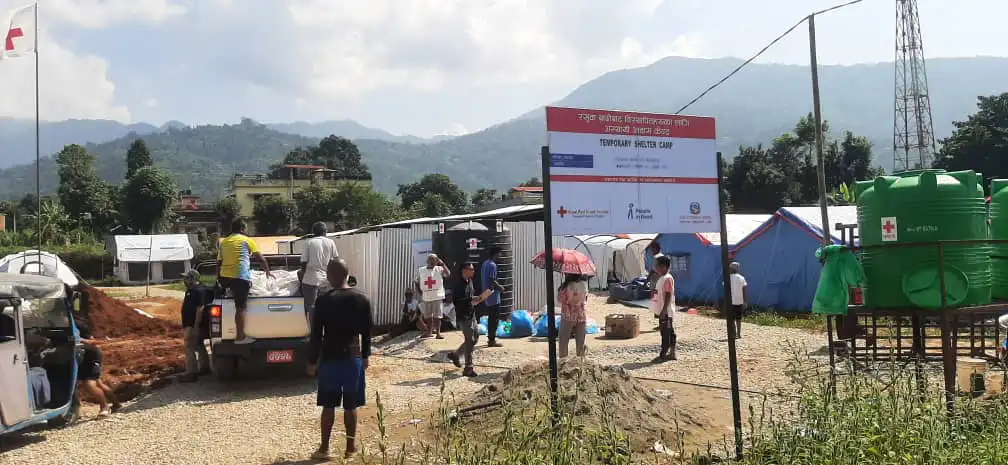
皮卡车卸下白色大包;右侧是水箱与蓝色帐篷,左侧是三轮车 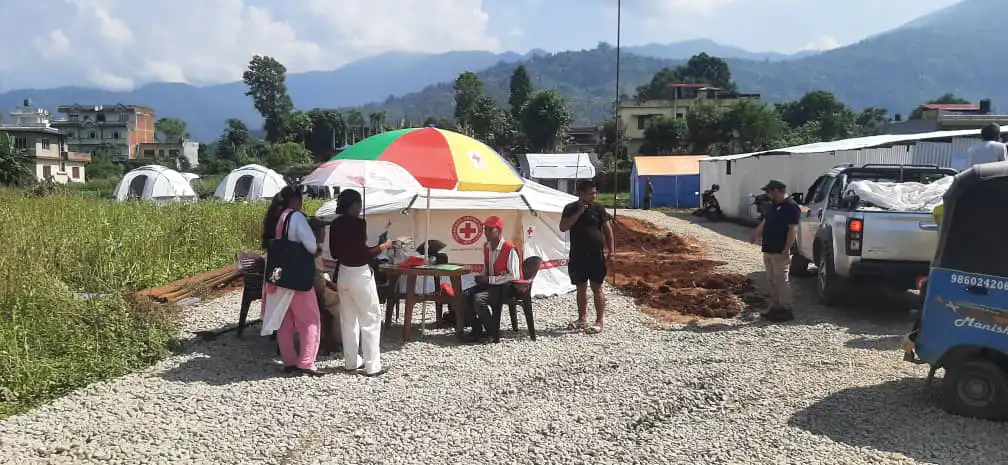
红十字志愿者坐在遮阳伞下的登记桌,居民在桌前办理
(三)Thilagaun Holding Center|10月1日 48 套
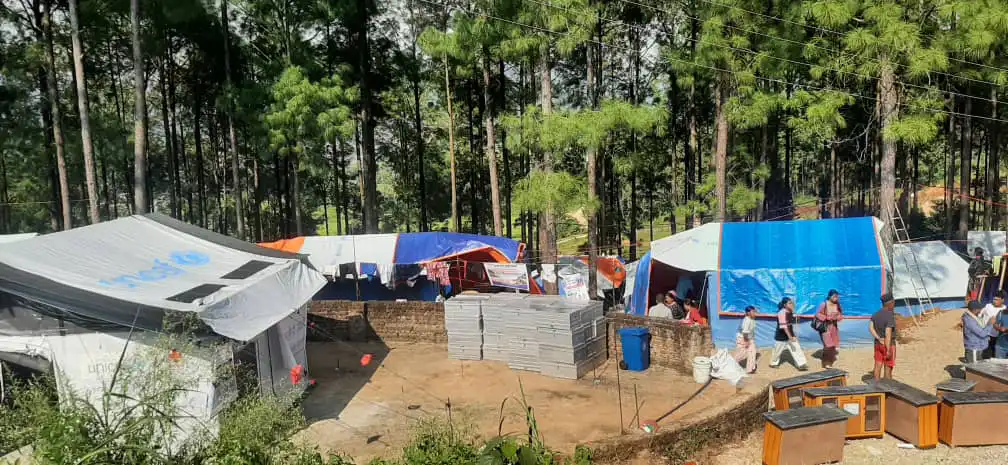
营地入口:门楼挂着尼泊尔文牌子(联络处),门内是松林中的蓝色帐篷 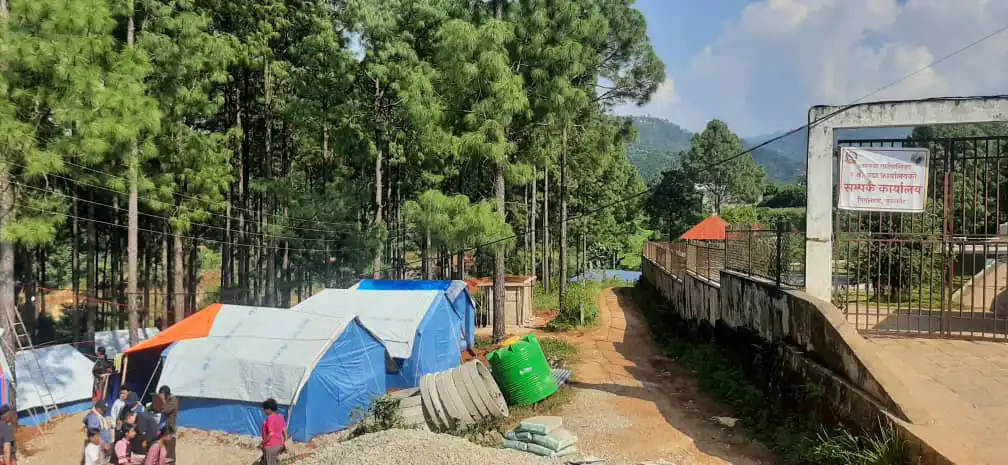
松林中的营地全景:UNICEF 标识的帐篷、蓝色帆布帐篷,前方成排木制小柜
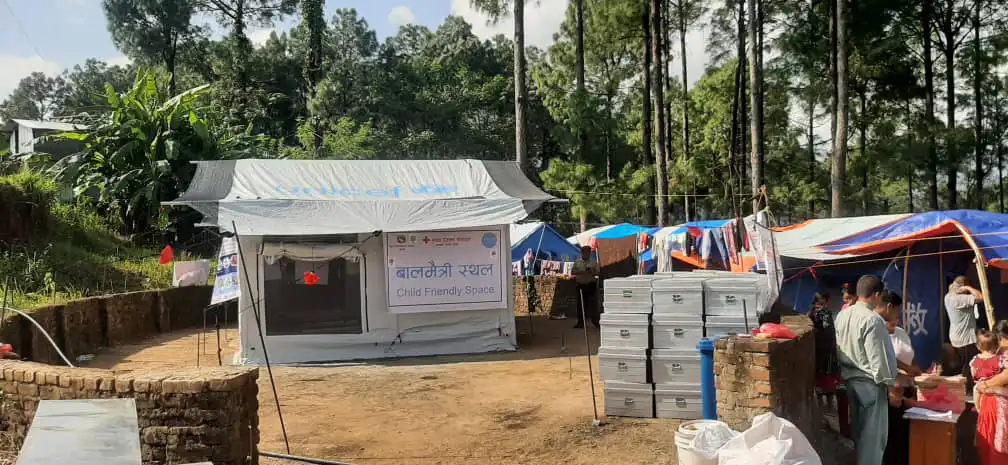
- 建在松林里的山坡营地:与前两处不同,这里是林间的小型营地,物资进出要经过一条窄土路,雨季路况可能影响补给。
- 服务比较齐全:有儿童友善空间、成叠的储物箱、储水袋、木制小柜和垃圾桶,说明饮水、儿童照护与日常用品已有安排。
- 发放在营地内进行:登记桌前有人排队,与其他营地的做法一致。(照片中没有看到卫生包的特写。)
(四)Ward 5 MCDS Camp(Lamibagaicha Tent House)|10月1日 25 套
Eddy 的记录写作 “Ward No. 5 MCDS Camp,Shree Chandrajyoti 中学旁”,这是 MCDS 自己支持的小型帐篷营地:
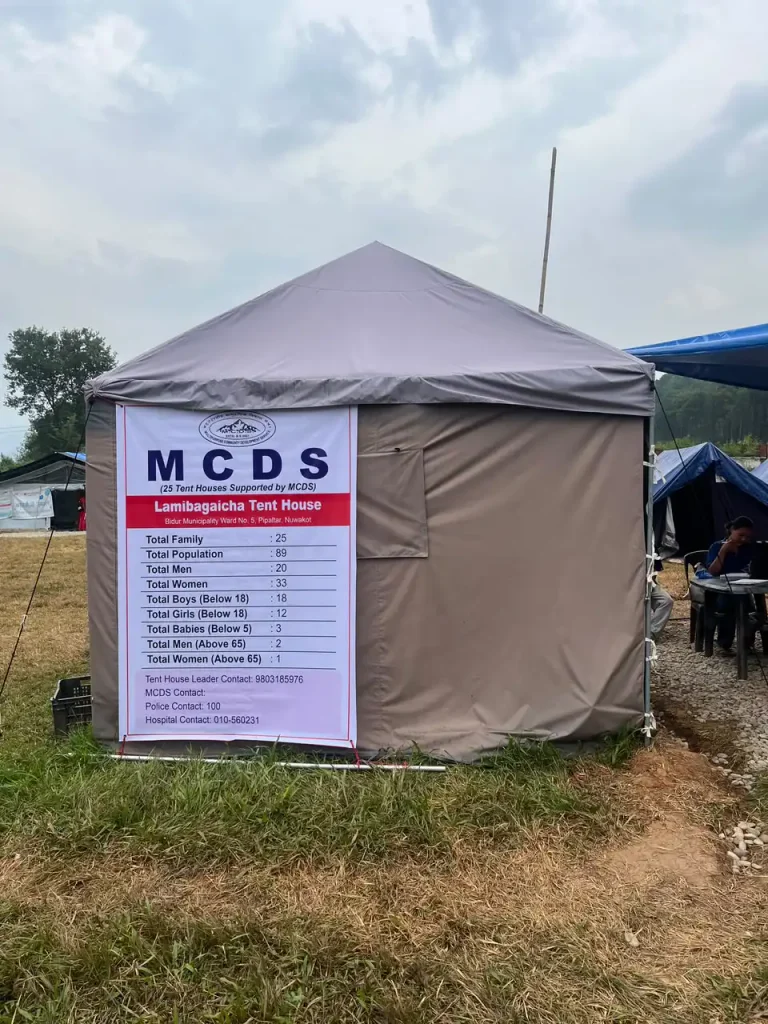
这块公告牌是本期最完整的“人口资料”,直接来自现场:MCDS 支持 25 顶帐篷、25 户、共 89 人。各类别加总刚好是 89 人,没有重复。
- 成年女性 34 人(含 65 岁以上 1 人),约占 38%
- 18 岁以下儿童 30 人 + 5 岁以下婴幼儿 3 人,共 33 人,约占 37%
- 成年男性 22 人(含 65 岁以上 2 人),约占 25%
- 平均每户约 3.6 人
女性与儿童合计超过七成,这正是卫生包要包含卫生巾、洗发水、儿童袜子的原因。
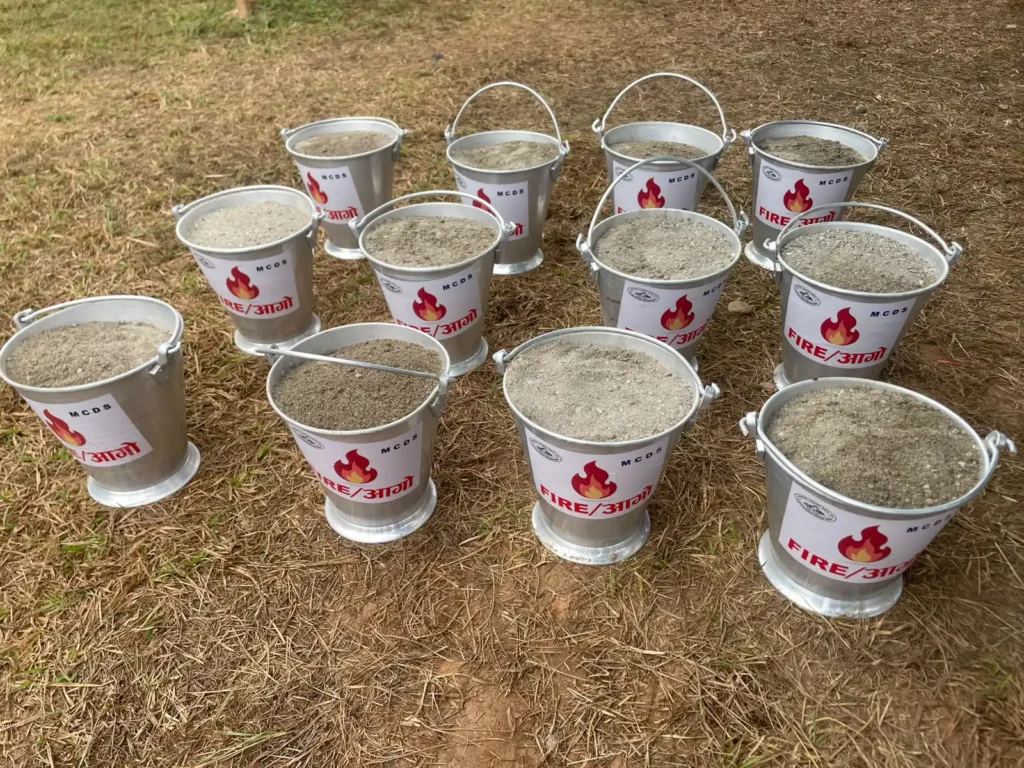
MCDS 标示的“FIRE”防火沙桶,一排十多只 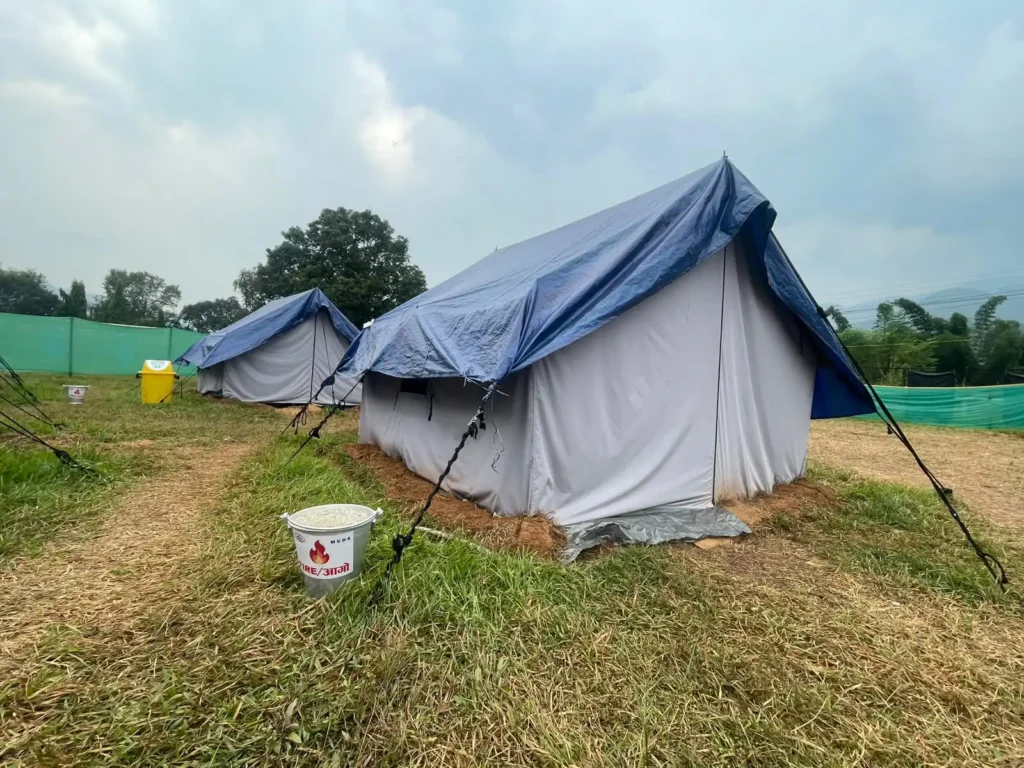
帐篷旁的防火桶、黄色垃圾桶与绿色围网;帐篷顶加盖蓝色防水布(地点未标注,应为 MCDS 支持的营地)
MCDS 在营地做的不只是“搭帐篷”:沙桶用于防火,垃圾桶处理环境卫生,绿色围网应是遮挡与分区之用,加盖的防水布应对降雨。营地仍是过渡性质,防火、卫生、妇幼安全、医疗联系与日常管理,决定了家庭能否真正从紧急避难走向生活恢复。
(五)Save the Children camp(Transitional Shelter Camp)|Pipaltar|10月2日 45 套+毛毯
Eddy 发回这个营地的照片时写道:“Much bigger and better tents here. 45 families. Got nice view.”——这里的帐篷大得多、好得多,共 45 户,景色也好。45 户与当天发放的 45 套正好对应,一户一套。
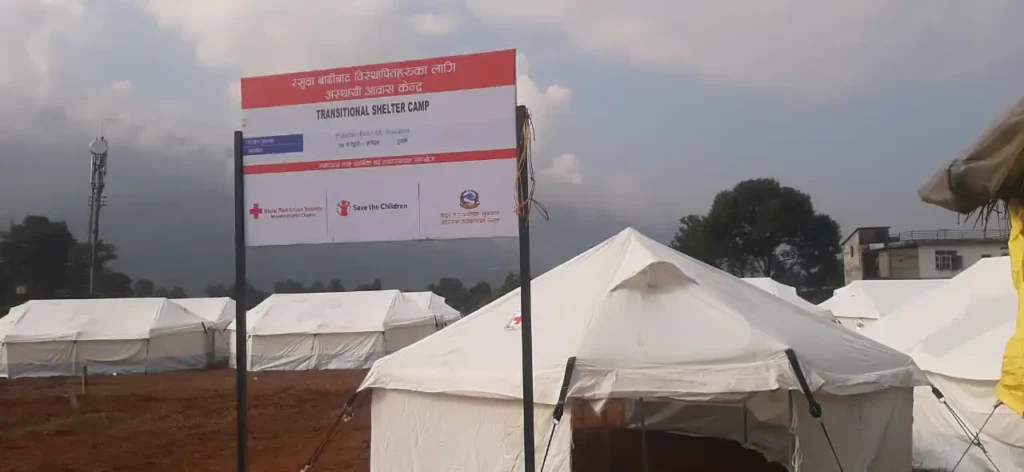
标牌:Transitional Shelter Camp(Pipaltar‑Bidur 05),标识为 Nepal Red Cross Society、Save the Children 与 Bidur 市政府 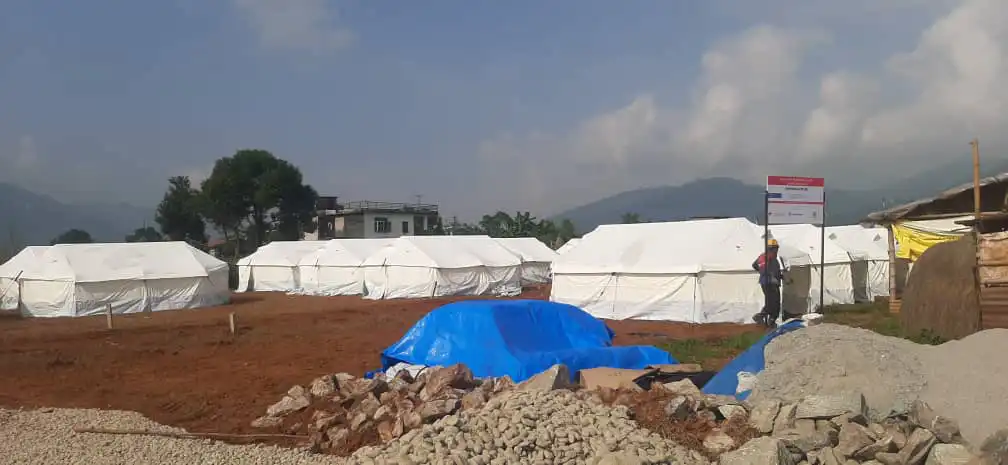
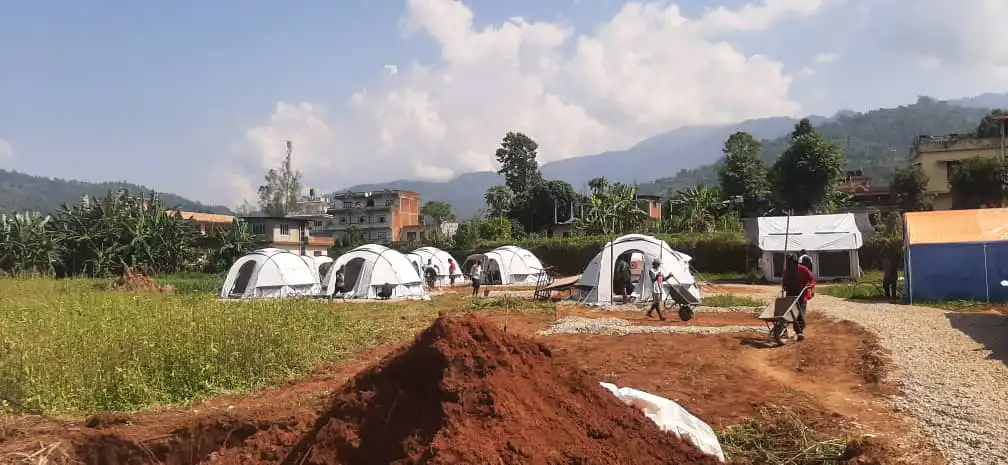
成排白色帐篷,地面是新整出的红土,旁边仍堆着碎石与建材
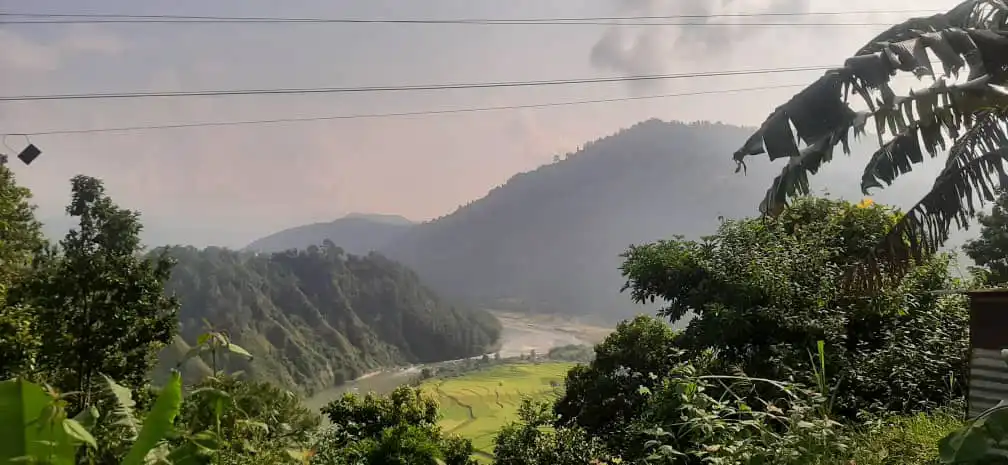
从营地向下拍摄的山谷与河道;营地位于高处,视野开阔
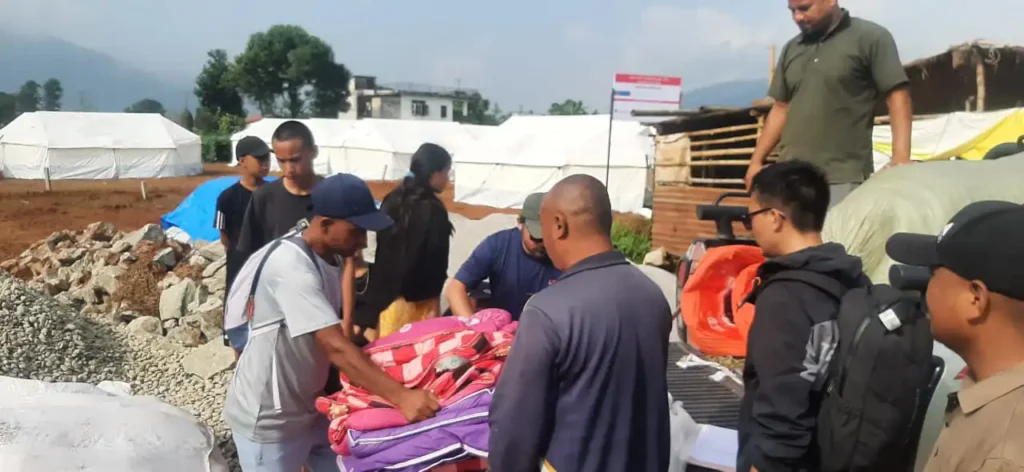
皮卡车旁发放:工作人员搬下成叠花色棉被,另有人手持登记表 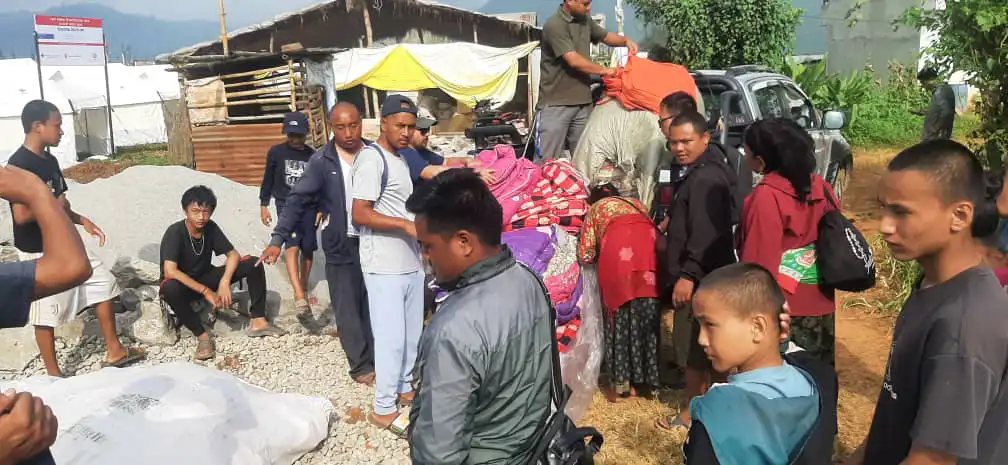
车旁堆放成捆棉被,居民围拢等候 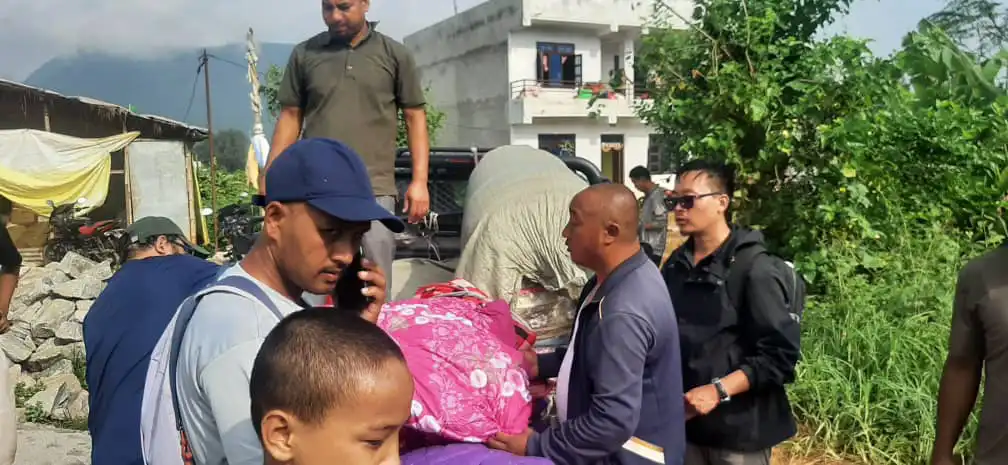
居民抱着粉红色棉被,正与同伴通电话联系 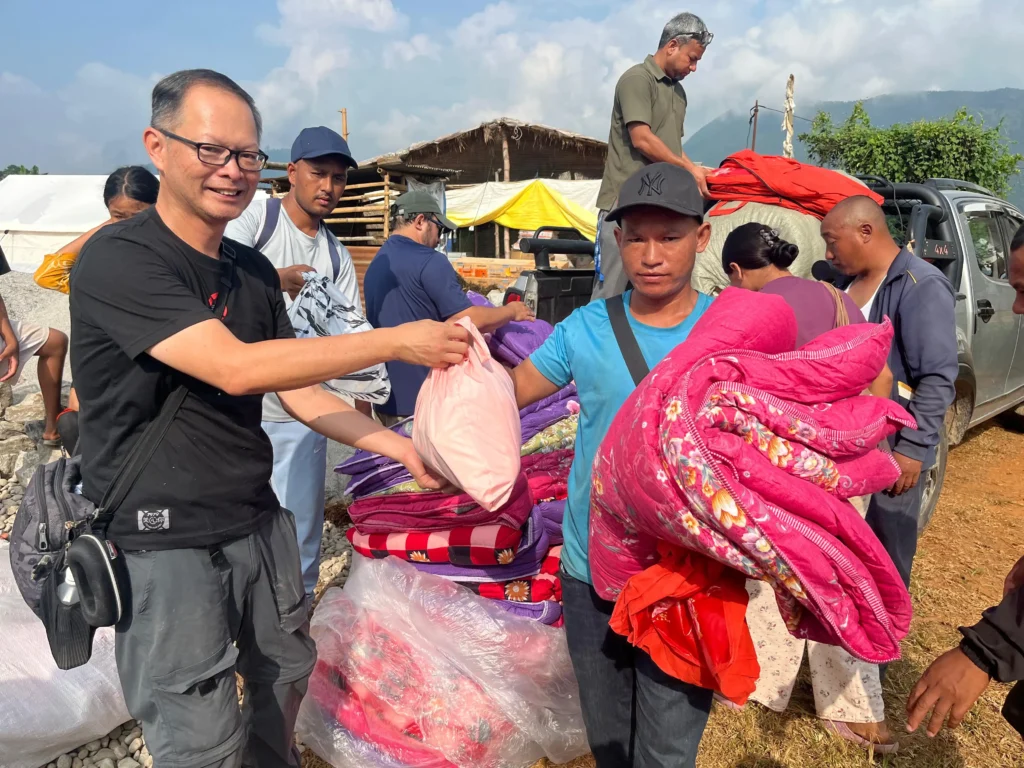
7979 同工Eddy 把浅粉色卫生包递给居民,旁边另一位志工正抱起整条棉被
- 卫生包和棉被一起发:居民一次领到卫生包与厚实的花色棉被,有的一次抱走一整条,不必分两次排队。
- 条件较好但仍在建设:帐篷整齐成排、尺寸较大,地面刚整平,旁边仍有建材,营地还在完善。
- 与 India Red Cross Camp 是两个营地:两处标牌不同(Transitional 与 Temporary,合作方分别是 Save the Children 与 People in Need),同在 Pipaltar‑Bidur 05。
(六)Kashita 与 Majhigaun|10月2日 104 套与 37 套
这两处目前只有 Eddy 的数字记录,没有收到照片,具体位置与受益户数也待 MCDS 补充。Kashita 的 104 套是 10月2日最大的一笔;Majhigaun 的 37 套同时发放了毛毯。
(七)Mandredhung(Bidur Ward 6)|10月3日 150 户
MCDS 在 Bidur 第 6 选区的 Mandredhung,为 150 户同时发放了棉被/毛毯与卫生包。该区域在第一阶段也曾获援助(见第六期)。
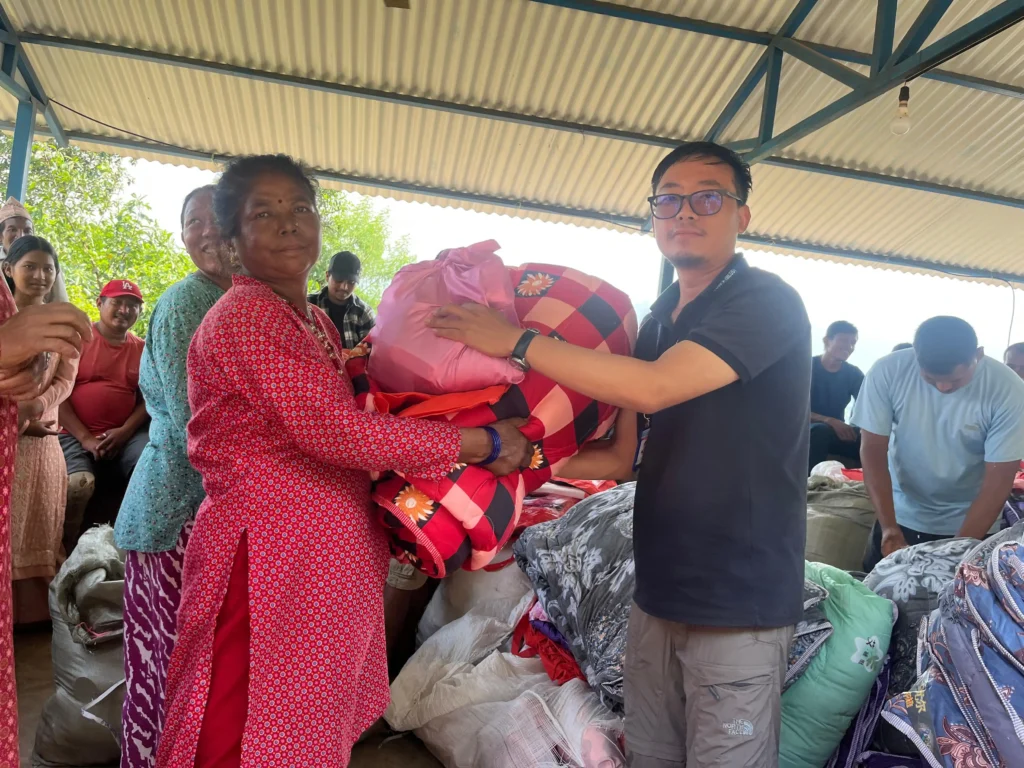
10月3日 Mandredhung:MCDS 工作人员把整条红格棉被连同粉红色卫生包交给一位妇女 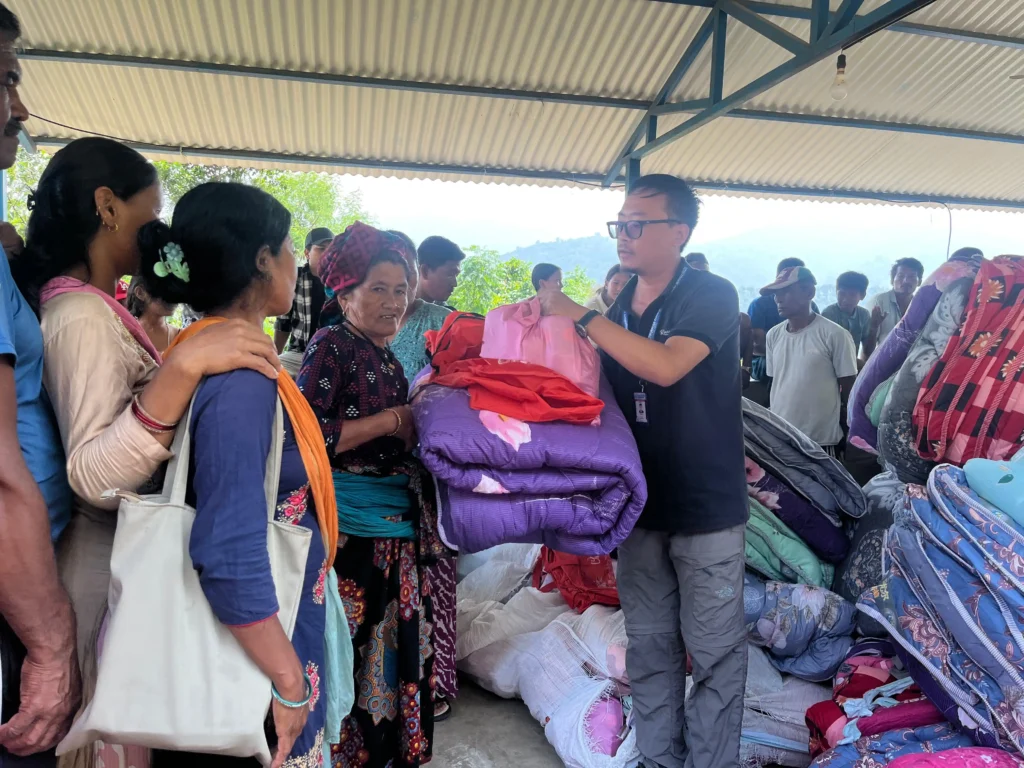
同一场发放:居民排队等候,桌前叠放着各种花色的棉被和白色大包
- 发放地点是社区公共棚屋:铁皮屋顶的开敞空间,背景是山坡,不是营地;说明援助已延伸到没有集中安置点的村落。
- 有 MCDS 人员负责:发放者佩戴 MCDS 工作证,排队秩序良好,前排领取者多为妇女,也有孩子在场。
3.5 保暖物资小结
MCDS 原计划发放 500 条毛毯。从记录看,10月2日 Save the Children camp(45 户)、Majhigaun(37 套)和 10月3日 Mandredhung(150 户)三处的发放里包含了棉被或毛毯,按同批家庭推算涉及约 232 户,但各处的条数、每户几条都没有记录,总条数待 MCDS 确认。进入冬季,山区夜间会明显转冷,帐篷与铁皮屋的保暖需求会越来越明显;随着新营地陆续成立,棉被与毛毯还需要继续寻找新的发放点(Eddy 10月2日的建议)。
四、7979 做了什么
4.1 筹款进展
| 原定筹款目标 | RM 70,000 |
| 累计收到善款(截至 2026年10月15日) | RM 126,619.67 |
| 超出目标 | RM 56,619.67(约达成 181%) |
7979将继续与 MCDS 等当地伙伴同行,按现场实际需要推进后续的恢复与重建。9月29日,Eddy 已把目前可动用的预算情况告知 Pr. Jhaggu,方便当地团队提前规划。
4.2 Eddy 的现场工作
| 9月29日 | 与总部讨论预算与下一步部署;把可用预算告知 Pr. Jhaggu。 |
| 9月30日 | 下午协助分装家庭卫生包(MCDS 以 UNFPA 清单为参考,整备量800 套);傍晚由加德满都前往 Bidur(约 3 小时车程),夜宿当地教会,并回报 Bada Choudara 营地的土地争议与铁皮屋兴建情况。MCDS 除卫生包外,另将发放 500 条毛毯。 |
| 10月1日 | 到五处安置点协助发放,确认发放 314 套。 |
| 10月2日 | 继续发放,共 186 套:Save the Children camp 45 套(另加毛毯)、Kashita 104 套、Majhigaun 37 套(另加毛毯);下午至傍晚整理发放资料、提出建议,并在 Bidur 收尾,准备返回加德满都。 |
| 10月3日起 | 结束约一个月的现场协助,启程回国;其后继续与当地团队保持联络。 |
| 10月3日(MCDS) | MCDS 在 Bidur Ward 6 的 Mandredhung 为 150 户发放棉被/毛毯与卫生包。 |
4.3 Eddy 给 MCDS 的建议(10月2日)
- 心理社会支持:拟建议由一位曾在 MCDS 任职、现在经营足球队的前同工,与 NBCC 儿童事工负责人合作,为儿童办一场心理社会支持活动。
- 物资发放:家庭卫生包、棉被毛毯可继续,随着更多地区能进入、新营地陆续成立,持续寻找新的发放地点。
- 返校用品:返校包需把学习用具一并考虑,Eddy 正在收集更多资料。
- 生计与住房:目前没有生计项目的方案;半永久房屋仍在等待政府的指引,另一种设想是购买或租用土地来建屋,尚属构想。
五、问责摘要
| 地点10月1日(5 处):Bada Choudara 营地(144)、Pipaltar Ward 5 India Red Cross Camp(70)、Thilagaun Holding Center(48)、Lito Holding Centre(27)、Ward 5 MCDS Camp(25)。10月2日(3 处):Save the Children camp(45)、Kashita(104)、Majhigaun(37)。10月3日(1 处):Bidur Ward 6,Mandredhung(150 户)。 | |
| 受益对象受灾后居住在安置点、以及村落里的家庭。每套卫生包供一户使用,已确认合计约 650 户(314 + 186 + 150);实际受益人数待 MCDS 的登记名单确认,不重复计算。 | |
| 物资家庭卫生包:整备 800 套,已确认发放 650 套,每套 19 项、成本约 NPR 2,500。棉被/毛毯:计划 500 条;10月2日、3日三处发放中包含,总条数待确认。 |
以上数字都是现场回传与照片核对的结果,不是 MCDS 的正式发放报告。我们会在取得 MCDS 的 Distribution Report 后,再对照地点、日期、数量与资金来源。
六、下一阶段与代祷
接下来的重点:儿童返校用品(含学习用具)、冬季保暖、妇女尊严包、心理社会支持,同时继续为家庭卫生包和棉被寻找新的发放点;半永久安置待政府指引,目前尚无生计项目。
请为尼泊尔祷告
- 为 MCDS 及当地志工的安全与健康。
- 为 Rasuwa、Nuwakot 及 Dhading 的灾后恢复与重建。
- 为受灾家庭的生活、居住需要,以及孩子顺利返校。
- 为下一阶段的援助与后续恢复工作,求上帝赐下智慧,并预备所需的资源。
洪水退去,救援仍然继续。我们继续与尼泊尔当地伙伴同行。
附:数据与编辑说明
1. 主要来源:Eddy 与总部的 WhatsApp 记录(9月29日–10月6日)、MCDS 卫生包品项表(9月30日)、Eddy 10月1日手写发放记录、10月2日发放记录(10月8日补发)、10月6日补报、7979 对外简报稿(10月2日)、现场照片 34 张(已剔除重复)。
2. 募款数字:以 9月30日对外简报及 7979 同工确认的 RM 129,019.67 为准。
3. 整备量与发放量:卫生包整备量800 套。已确认发放 650 套是三天记录的加总,其中 10月3日 150 为户数,按每户一套推算;不排除各场次之间有重叠或遗漏,待 MCDS 的正式发放报告核对。
4. 10月2日记录的理解:Eddy 的原文为 “Save the Children camp (45 sets plus fibre filled blanket)、Kashita 104 hygiene kits、Majhigaun 37 Hygiene kits plus Blankets”。本报告把 “sets” 理解为卫生包,毛毯的条数均未记录。Kashita、Majhigaun 的具体位置与照片尚缺。
5. Pipaltar 的两个营地:India Red Cross Camp(标牌 Temporary Shelter Camp,Nepal Red Cross Society、People in Need、Bidur 市政府)与 Save the Children camp(标牌 Transitional Shelter Camp,Nepal Red Cross Society、Save the Children、Bidur 市政府)是两处不同的营地,同在 Pipaltar‑Bidur 05。Eddy 称前者为 “India” Red Cross,而标牌写 Nepal Red Cross,待确认。
6. 卫生包内容:本报告以 MCDS 的品项表(19 项)为准。实际装配以 MCDS 为准。
7. 地名拼写:同一营地在不同来源中写作 Bada Choudara、Bada Chautara(现场标牌)、Bata Choudara(手写记录),本报告统一用 Bada Choudara;Mandredhunga 与 Mandredhung 并存,沿用第五期的 Mandredhung;Kashita、Majhigaun 照 Eddy 的拼写。
8. 照片地点:以 Eddy 回传照片时的说明为准——2.2 的营地照片和 Bada Choudara 的四张发放照片;India Red Cross Camp、Thilagaun、Save the Children camp 各自的照片按 Eddy 分组发来的说明归类;Mandredhung 的两张按补报时间归入。防火桶旁帐篷一张未注明地点,按 MCDS 标识判断为其支持的营地。Lito、Kashita、Majhigaun 没有对应照片。
9. 未纳入的内容:Eddy 对营地管理安排及各机构在营地中能见度的个人观察,属内部沟通,本报告不予收录;两处山体滑坡来自社交媒体视频,未经核实,仅作提醒。
Nepal Flood Disaster Response – Phase Progress Report (6)
Entering Phase 2: Family Hygiene Kits and Warm Clothing Supplies
1. Overview of This Update
This week, the focus of relief efforts shifted from simply ensuring the availability of supplies to identifying what affected families need most at this stage. After reviewing the outcomes of the first phase, MCDS and NBCC shifted their priorities towards family hygiene, warmth, returning to school, and psychosocial support. The key relief items distributed during this reporting period were family hygiene kits and quilts/blankets.
After assisting MCDS with the preparation and distribution of relief supplies on the ground, Eddy returned in early October.
| RM 126,619.67 Total donations received by 7979 (as of 15 October) | 800 sets Total family hygiene kits prepared | 650 sets Confirmed distributions (1–3 October, across 9 locations) | 25 households · 89 individuals MCDS-supported tent camp in Pipaltar |
Highlights:
- Donations have exceeded the original target. The initial fundraising target was RM 70,000. To date, a total of RM 126,619.67 has been received, exceeding the target by RM 56,619.67 (approximately 181% of the target achieved). We sincerely thank every individual, church, and partner who has contributed to this relief effort.
- A total of 800 family hygiene kits were prepared, of which 650 kits (approximately 81%) have been confirmed as distributed. This includes 314 kits distributed across five locations on 1 October, 186 kits across three locations on 2 October, and 150 households assisted in Mandredhung on 3 October. As the 3 October record indicates the number of households rather than kits, the total is calculated on the assumption of one kit per household.
- The original plan was to distribute 500 quilts/blankets. Distributions carried out at three locations on 2 and 3 October included quilts or blankets. However, the quantities distributed at each location were not recorded. The total number is pending confirmation from MCDS and is therefore not included in this update.
2. Disaster Situation and Field Updates: Life in Temporary Shelters
2.1 Emerging Needs of Affected Families
As some roads gradually reopened, MCDS and its local partners were able to reach more communities. They discovered that some affected families were temporarily staying in local residents’ homes rather than in designated evacuation centres. As a result, these families were less likely to receive assistance through the usual relief distribution channels.
Local government community leaders have since accompanied relief teams on house-to-house visits to identify and support these families, ensuring that their needs are not overlooked.
Recent adverse weather conditions in Nepal have also caused temporary delays to some relief operations. The team continues to plan subsequent relief efforts according to weather and road conditions.
On 29 September, Eddy also reported another landslide near Lalitpur in the Kathmandu Valley. Videos circulating on social media also showed landslides in Mustang, northwestern Nepal. Both locations are relatively far from MCDS’s operational areas and are not included in the current relief response. Nevertheless, these incidents serve as reminders that geological conditions in Nepal’s mountainous regions remain unstable.
2.2 Bada Choudara Temporary Shelter Camp: A Glimpse Through Photographs
This temporary shelter camp received the largest quantity of relief supplies during this reporting period.
After arriving in Bidur on the evening of 30 September, Eddy reported that the camp was located on religious premises where land ownership was disputed with local residents. The authorities were constructing approximately 46 temporary shelters using corrugated galvanised iron (CGI) sheets, with each shelter intended to accommodate one household.
The following photographs were taken and shared by Eddy from the camp, offering a glimpse into the living conditions of the affected families:
Camp signboard: Bada Chautara Holding Center (Bidur Municipality), featuring the words “Bhotekoshi Flood Response” Relief supplies being unloaded from a pickup truck, with the camp signboard and a large blue water tank visible in the background Temporary CGI shelters: Steel frames and wall panels are in place, while the roofs remain unfinished Rows of partitioned CGI shelters, with tarpaulin tents still in use on the right
WHO medical tent with medicine boxes inside and construction steel bars stacked in front
- Basic facilities are in place: The camp has a large water storage tank, a Child Friendly Space tent, and a WHO medical tent, indicating that arrangements have been made for drinking water, children’s needs, and basic healthcare services.
- Housing remains in transition: The CGI shelters appear to have only wall frames, with no completed roofs visible. Meanwhile, some families are still living in blue tarpaulin tents nearby. The expected completion date cannot be determined from the photographs and will need to be confirmed with MCDS.
- Transportation relies on pickup trucks and manual labour: No large vehicles were visible during unloading. The final stage of transporting relief supplies still relies on pickup trucks and manual handling, highlighting the need to coordinate the preparation and distribution of supplies according to road conditions.
3. MCDS Relief Efforts
3.1 Priorities for the Second Phase
After reviewing the progress of relief efforts, MCDS and NBCC gradually shifted their focus towards school supplies for children returning to school, winter and warm clothing supplies, family and women’s hygiene supplies, and psychosocial support. Preparations are currently underway for 800 family hygiene kits and 500 blankets.
3.2 Family Hygiene Kits: 19 Items per Household
Using the UNFPA checklist as a reference, MCDS developed a family hygiene kit containing 19 essential items, all packed into a reusable carry bag, with one kit allocated to each household. The estimated preparation cost is NPR 2,500 per kit, compared with a retail price of approximately NPR 3,500. Preparing the kits independently saves around NPR 1,000 per kit (approximately 29%). Based on these estimates, the total preparation cost for 800 kits is approximately NPR 2,000,000, while the estimated cost of the 650 kits already distributed is NPR 1,625,000. These figures are estimates and remain subject to confirmation against MCDS’s official financial records.
| Category | Contents (Per Household) |
|---|---|
| Personal Hygiene (7 items) | 4 toothbrushes, 1 tube of toothpaste, 1 bottle of shampoo, 2 bars of bathing soap, 1 small towel, 1 bottle of hand wash, 1 plastic cup |
| Clothing and Laundry (3 items) | 2 bars of laundry soap, 4 pairs of underwear (2 men’s and 2 women’s), 3 pairs/sets of socks (men’s, women’s and children’s) |
| Women’s Hygiene and Daily Care (6 items) | 1 pack of sanitary pads, 1 comb, 1 nail clipper, 1 razor, 1 pack of cotton buds, 1 pack of adhesive bandages |
| Other Essentials (3 items) | 1 roll of toilet paper, 1 pack of garbage bags, 1 carry bag (for packing all items) |
30 September: Volunteers packing family hygiene kits inside a church hall. Toothbrushes and toothpaste are placed in plastic cups, while carry bags and cleaning supplies are arranged across the floor
3.3 Distribution Overview: Three Days, Nine Locations
The following records are based on Eddy’s handwritten notes from 1 October, written report for 2 October (submitted on 8 October), and supplementary report for 3 October. “Kits” refers to family hygiene kits. The quilts/blankets column indicates whether these items were distributed, as the quantities were not recorded.
| Date | Distribution Location | Hygiene Kits | Quilts/Blankets |
|---|---|---|---|
| 1 Oct | Bada Choudara Camp | 144 | – |
| Pipaltar Ward 5 India Red Cross Camp | 70 | – | |
| Thilagaun Holding Center | 48 | – | |
| Lito Holding Centre | 27 | – | |
| Ward 5 MCDS Camp (near Shree Chandra Jyoti Secondary School) | 25 | – | |
| Subtotal (1 Oct) | 314 | ||
| 2 Oct | Save the Children camp(Transitional Shelter Camp) | 45 | Yes (fibre-filled blankets) |
| Kashita | 104 | – | |
| Majhigaun | 37 | Yes | |
| Subtotal (2 Oct) | 186 | ||
| 3 Oct | Bidur Ward 6,Mandredhung | 150 (households) | Yes (quilts) |
| Total Confirmed Distribution | 650 | 81% of the 800 kits prepared |
Notes: The 2 October records, “45 sets plus fibre filled blanket” and “37 Hygiene kits plus Blankets”, are interpreted as distributions of both hygiene kits and blankets. For 3 October, the 150 households are estimated to have received one hygiene kit each. Approximately 150 kits remain from the total of 800 prepared.
| Feedback from the Field: On 2 October, Eddy reported that after two consecutive days of distributing family hygiene kits, affected families—especially women—were delighted to receive them. Shampoo was particularly appreciated. Some recipients were so eager to use it that they went to wash their hair even before the distribution had finished. Encouraged by this positive response, Eddy recommended that MCDS continue distributing family hygiene kits to affected families.。 |
3.4 Photographs and Observations from Distribution Locations
(1) Bada Choudara Camp | 1 October | 144 Kits
The following four photographs were taken at Bada Choudara Camp, as indicated by Eddy when sharing them.
Distribution beside the WHO tent: Eddy handing a pink hygiene kit bag to an affected resident Registration personnel recording details at a desk in the foreground, while residents gather nearby to await distribution A young resident receiving an orange carry bag Eddy (wearing a black 7979 shirt) handing a hygiene kit to a woman, while registration continues in the lower-left corner
- Registration and orderly distribution: Several photographs show registration desks, paper forms, and registration personnel wearing identification badges, while residents wait to receive their supplies. These records provide a basis for subsequent verification of recipient lists and distribution quantities.
- Family-oriented assistance: Both men and women were among the recipients, with children also present. Each hygiene kit contains men’s and women’s underwear, sanitary pads, and children’s socks, reflecting an approach designed to meet the needs of the entire household.
- Participation of local personnel: In addition to Eddy, several local personnel were seen assisting with transporting supplies and registration. The distribution was therefore a collaborative effort rather than an operation carried out solely by the visiting relief team.
(2) India Red Cross Camp | Pipaltar Ward 5 | 1 October | 70 Kits
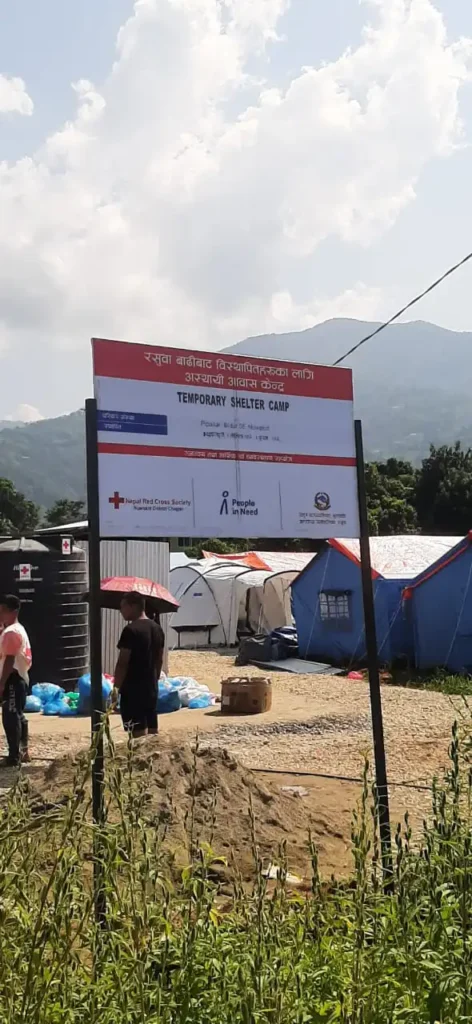
The signboard identifies the site as a Temporary Shelter Camp. The Nepali text indicates that it was established for people displaced by the floods in Rasuwa, with the location stated as Pipaltar-Bidur 05, Nuwakot. The logos displayed at the bottom represent the Nepal Red Cross Society (Nuwakot District Chapter), People in Need, and Bidur Municipality.
- Camp identification requires clarification: Eddy recorded the location as “India Red Cross Camp”, while the signboard identifies the Nepal Red Cross Society. The relationship between these names remains to be confirmed.
- Multi-agency involvement: The camp involves the Red Cross, an international organisation, and local government authorities. MCDS was responsible for distributing this batch of family hygiene kits at the site.
- Water supply facilities: A large green water tank bearing the Red Cross emblem was visible at the camp, indicating that water storage facilities were in place.
Large white supply bags being unloaded from a pickup truck, with a water tank and blue tent on the right and a three-wheeler on the left A Red Cross volunteer managing registration under a sun umbrella as residents approach the desk
(3) Thilagaun Holding Center | 1 October | 48 Kits
Camp entrance: A gateway displaying a Nepali sign for the contact office, with blue tents visible among pine trees inside Overview of the camp among pine trees, showing a UNICEF-branded tent, blue tarpaulin tents, and rows of small wooden cabinets in the foreground
- A hillside camp surrounded by pine trees: Unlike the previous two locations, this is a smaller camp situated in a wooded area. Supplies must be transported along a narrow dirt road, where conditions during the rainy season may affect deliveries.
- Several basic facilities are available: The camp has a Child Friendly Space, stacked storage containers, water storage bags, small wooden cabinets, and rubbish bins. These suggest that arrangements have been made for drinking water, childcare, and daily necessities.
- Distribution took place within the camp: Residents were seen queuing at a registration desk, following a similar distribution process to that observed at other camps. However, no close-up photographs of the hygiene kits were available.
(4) Ward 5 MCDS Camp (Lamibagaicha Tent House) | 1 October | 25 Kits
Eddy’s records identify this location as “Ward No. 5 MCDS Camp, near Shree Chandrajyoti Secondary School”. This is a small tent camp supported directly by MCDS.
The information board provides the most comprehensive population data available in this reporting period. According to the figures displayed on-site, MCDS supports 25 tents accommodating 25 households, with a total of 89 individuals. The population figures across all categories add up to exactly 89, with no duplication.
- Adult women: 34 individuals (including one aged 65 or above), accounting for approximately 38% of the population.
- Children: 30 under the age of 18, plus 3 children under the age of 5, totalling 33 individuals, or approximately 37%.
- Adult men: 22 individuals (including two aged 65 or above), representing approximately 25%.
- Average household size: Approximately 3.6 individuals.
Women and children together account for more than 70% of the camp’s population. This highlights the importance of including sanitary pads, shampoo, and children’s socks in the family hygiene kits.
More than ten fire safety sand buckets labelled “FIRE” and bearing the MCDS logo Fire safety buckets, a yellow rubbish bin, and green mesh fencing beside a tent covered with additional blue waterproof tarpaulin (Exact location unconfirmed; believed to be an MCDS-supported camp)
MCDS’s support at the camp goes beyond simply providing tents. Sand buckets are available for fire safety, rubbish bins help maintain environmental hygiene, and green mesh fencing appears to provide screening and separate different areas. Waterproof tarpaulins offer additional protection against rainfall.
However, the camp remains a temporary living arrangement. Fire safety, sanitation, the safety of women and children, access to medical services, and daily camp management are all essential in helping affected families move beyond emergency shelter towards recovery.
(5) Save the Children Camp (Transitional Shelter Camp) | Pipaltar | 2 October | 45 Kits + Blankets
When sharing photographs of this camp, Eddy commented:
“Much bigger and better tents here. 45 families. Got nice view.”
The camp accommodates 45 households, corresponding exactly to the 45 hygiene kits distributed that day, suggesting one kit per household.
Signboard: Transitional Shelter Camp (Pipaltar-Bidur 05), displaying the logos of the Nepal Red Cross Society, Save the Children, and Bidur Municipality ows of white tents on recently levelled red soil, with gravel and construction materials still piled nearby
View of the valley and river from the elevated camp, offering a wide, unobstructed landscape.
Distribution beside a pickup truck: Relief workers unloading stacks of patterned quilts, while another worker holds a registration form. Bundles of quilts stacked beside a vehicle as residents gather to await distribution A resident holding a pink quilt while speaking to a companion on the phone Eddy from 7979 handing a light pink hygiene kit bag to a resident, while another volunteer carries an entire quilt nearby
- Hygiene kits and blankets distributed together: Residents received both hygiene kits and thick, patterned quilts during the same distribution. Some were seen carrying away an entire quilt, eliminating the need to queue separately for the two types of supplies.
- Better facilities, but construction is still ongoing: The tents are larger and arranged in neat rows. The ground appears to have been recently levelled, with construction materials still visible nearby, indicating that the camp is still being developed.
- Separate from the India Red Cross Camp: Although both camps are located in Pipaltar-Bidur 05, they have different signboards and partner organisations. This site is identified as a “Transitional Shelter Camp” associated with Save the Children, while the India Red Cross Camp is labelled a “Temporary Shelter Camp” and associated with People in Need.
(6) Kashita and Majhigaun | 2 October | 104 Kits and 37 Kits
Only Eddy’s numerical distribution records are currently available for these two locations. No photographs have been received, and their exact locations and the number of beneficiary households remain to be confirmed by MCDS.
The 104 hygiene kits distributed in Kashita represented the largest single distribution on 2 October. In Majhigaun, 37 hygiene kits were distributed together with blankets.
(7) Mandredhung (Bidur Ward 6) | 3 October | 150 Households
In Mandredhung, Bidur Ward 6, MCDS distributed quilts/blankets and hygiene kits to 150 households. This area had also received assistance during the first phase of relief efforts (see Update No. 6).
3 October, Mandredhung: An MCDS staff member handing a red-checkered quilt and a pink hygiene kit bag to a woman At the same distribution site, residents queue to receive supplies, with assorted patterned quilts and large white bags stacked on a table
- Distribution at a community shelter: The distribution took place in an open-sided structure with a corrugated metal roof, surrounded by hills. Unlike the tent camps, this was a community-based distribution site, indicating that relief efforts had extended to villages without centralised evacuation centres.
- Distribution managed by MCDS personnel: Staff wearing MCDS identification badges coordinated the distribution. Recipients queued in an orderly manner, with women making up a large proportion of those at the front of the queue. Children were also present.
3.5 Summary of Warmth and Bedding Supplies
MCDS originally planned to distribute 500 blankets. According to the available records, quilts or blankets were included in distributions at three locations:
- 2 October – Save the Children Camp: 45 households
- 2 October – Majhigaun: 37 hygiene kits distributed together with blankets
- 3 October – Mandredhung: 150 households
Based on the corresponding number of households or hygiene kits distributed, these three distributions are estimated to have reached approximately 232 households. However, the exact quantities of quilts or blankets distributed at each location, including the number provided per household, were not recorded. The total number distributed remains subject to confirmation by MCDS.
As winter approaches, nighttime temperatures in Nepal’s mountainous regions are expected to drop significantly. Families living in tents and temporary CGI shelters will face increasing challenges in keeping warm.
With new temporary shelter camps continuing to be established, there is also a growing need to identify additional distribution locations for quilts and blankets, as recommended by Eddy on 2 October.
4. What 7979 Has Done
4.1 Fundraising Progress
| Original fundraising target | RM 70,000 |
| Total donations received (as of 15 October 2026) | RM 126,619.67 |
| Amount exceeding the target | RM 56,619.67 (approximately 181% of the target achieved) |
7979 will continue working alongside MCDS and other local partners to support recovery and reconstruction efforts based on actual needs on the ground. On 29 September, Eddy informed Pr. Jhaggu of the available budget to help the local team plan the next stages of relief efforts.
4.2 Eddy’s Work on the Ground
| Date | Activities |
| 29 Sept | Discussed the budget and next steps with the headquarters team and informed Pr. Jhaggu of the available funds. |
| 30 Sept | Assisted in packing family hygiene kits in the afternoon. MCDS used the UNFPA checklist as a reference, with a total of 800 kits prepared. In the evening, Eddy travelled from Kathmandu to Bidur (approximately three hours by car) and stayed overnight at a local church. He also reported on the land dispute and the construction of temporary CGI shelters at Bada Choudara Camp. In addition to hygiene kits, MCDS planned to distribute 500 blankets. |
| 1 Oct | Assisted with relief distributions at five temporary shelter locations, with 314 hygiene kits confirmed as distributed. |
| 2 Oct | Continued relief distributions, with 186 hygiene kits distributed: 45 at Save the Children Camp (along with blankets), 104 at Kashita, and 37 at Majhigaun (along with blankets). From the afternoon to evening, Eddy compiled distribution records, shared recommendations, and wrapped up his work in Bidur before preparing to return to Kathmandu. |
| From 3 October onwards | Concluded approximately one month of on-site assistance and began his journey home. He continued maintaining communication with the local team afterwards. |
| 3 Oct (MCDS) | MCDS distributed quilts/blankets and hygiene kits to 150 households in Mandredhung, Bidur Ward 6. |
4.3 Eddy’s Recommendations to MCDS (2 October)
- Psychosocial support: Eddy proposed involving a former MCDS staff member who now manages a football team, in collaboration with the NBCC children’s ministry leader, to organise a psychosocial support activity for children.
- Relief supplies distribution: Continue distributing family hygiene kits and quilts/blankets. As more areas become accessible and new temporary shelter camps are established, the team should continue identifying additional distribution locations.
- Back-to-school supplies: Back-to-school kits should also include essential learning materials. Eddy was gathering further information to determine what should be included.
- Livelihoods and housing: No livelihood recovery programme has been proposed at this stage. Plans for semi-permanent housing remain pending government guidance. Another possibility under consideration is purchasing or renting land for housing construction, although this is still at the conceptual stage.
5. Accountability Summary
Distribution Locations | 1 October (5 locations): Bada Choudara Camp (144), Pipaltar Ward 5 India Red Cross Camp (70), Thilagaun Holding Center (48), Lito Holding Centre (27), Ward 5 MCDS Camp (25). 2 October (3 locations): Save the Children Camp (45), Kashita (104), Majhigaun (37). 3 October (1 location): Mandredhung, Bidur Ward 6 (150 households). |
| Families affected by the disaster who are staying in temporary shelters or living in villages. Each hygiene kit is intended for one household. The confirmed distribution records indicate approximately 650 households reached (314 + 186 + 150). The actual number of individual beneficiaries remains subject to verification against MCDS’s registration records, with care taken to avoid double-counting. | |
Relief Supplies | Family hygiene kits: 800 kits prepared, 650 kits confirmed as distributed. Each kit contains 19 items, with an estimated cost of NPR 2,500. Quilts/blankets: 500 blankets planned. These were included in distributions at three locations on 2 and 3 October, but the total quantity distributed remains to be confirmed. |
All figures above are based on field reports and cross-checking with photographs. They do not constitute MCDS’s official distribution report. Once MCDS’s official Distribution Report is received, we will verify the distribution locations, dates, quantities, and funding sources against the reported information.
6. Next Steps and Prayer Requests
The next phase of relief efforts will focus on back-to-school supplies for children (including learning materials), winter supplies, women’s dignity kits, and psychosocial support. At the same time, the team will continue identifying new distribution locations for family hygiene kits and quilts/blankets. Plans for semi-permanent housing remain pending government guidance, while no livelihood recovery programme has been established at this stage.
Pray for Nepal
- Pray for the safety, health, and well-being of MCDS staff and local volunteers.
- Pray for the recovery and reconstruction of communities affected by the disaster in Rasuwa, Nuwakot, and Dhading.
- Pray for the daily living and housing needs of affected families, and for children to return to school smoothly.
- Pray that God will grant wisdom and provide the necessary resources for the next phase of relief assistance and long-term recovery efforts.
The floodwaters have receded, but relief efforts continue. We remain committed to walking alongside our local partners in Nepal.
Appendix: Data Sources and Editorial Notes
1. Primary Sources: The information in this report is based on: WhatsApp correspondence between Eddy and the headquarters team (29 September – 6 October); MCDS’s family hygiene kit item list (30 September); Eddy’s handwritten distribution records (1 October); Distribution records for 2 October (submitted on 8 October); Supplementary report submitted on 6 October; 7979’s public briefing report (2 October); 34 field photographs, after removing duplicates.
2. Fundraising Figures: The total amount of RM 129,019.67 is based on the public briefing dated 30 September and confirmation from 7979 staff.
3. Prepared and Distributed Quantities: A total of 800 family hygiene kits were prepared. The reported distribution total of 650 kits is calculated from the records covering three days. The figure of 150 recorded on 3 October refers to households rather than kits and is therefore estimated on the basis of one kit per household. Potential overlaps or omissions between distribution sessions cannot be ruled out. These figures will be verified against MCDS’s official Distribution Report.
4. Interpretation of the 2 October Records. Eddy’s original report stated: “Save the Children camp (45 sets plus fibre filled blanket), Kashita 104 hygiene kits, Majhigaun 37 Hygiene kits plus Blankets.” For this report, “sets” is interpreted as family hygiene kits. The quantities of blankets distributed were not recorded. The exact locations and photographs of Kashita and Majhigaun are not yet available.
5. Two Separate Camps in Pipaltar: The India Red Cross Camp and Save the Children Camp are two distinct temporary shelter sites, both located in Pipaltar-Bidur 05.
– India Red Cross Camp: The signboard identifies it as a “Temporary Shelter Camp”, displaying the logos of the Nepal Red Cross Society, People in Need, and Bidur Municipality.
– Save the Children Camp: The signboard identifies it as a “Transitional Shelter Camp”, displaying the logos of the Nepal Red Cross Society, Save the Children, and Bidur Municipality.
Eddy referred to the first location as the “India Red Cross Camp”, while its signboard identifies the Nepal Red Cross Society. This discrepancy remains to be clarified.
6. Family Hygiene Kit Contents: The list of 19 items in this report is based on MCDS’s official item list. The actual contents and packing arrangements remain subject to confirmation by MCDS.
7. Place Name Spellings: Different spellings of certain locations appear across the source materials.
– Bada Choudara: Also recorded as “Bada Chautara” (on-site signboard) and “Bata Choudara” (handwritten records). This report consistently uses “Bada Choudara”.
– Mandredhung: Also appears as “Mandredhunga”. This report follows the spelling “Mandredhung”, as used in Update No. 5.
– Kashita and Majhigaun: Spellings follow Eddy’s original records.
8. Photograph Locations: Photograph locations are identified primarily according to the descriptions Eddy provided when sharing them.
– The camp photographs in Section 2.2 and the four distribution photographs from Bada Choudara are categorised according to Eddy’s descriptions.
– Photographs of India Red Cross Camp, Thilagaun, and Save the Children Camp are grouped based on Eddy’s accompanying information.
– The two photographs from Mandredhung are categorised according to the timing of the supplementary report.
– One photograph showing a tent beside a fire safety sand bucket was not labelled with a location. It has been attributed to an MCDS-supported camp based on the visible MCDS identification.
– No corresponding photographs are available for Lito, Kashita, or Majhigaun.
9. Information Excluded from This Report: Eddy’s personal observations regarding camp management arrangements and the visibility of different organisations within the camps were part of internal communications and have therefore been excluded from this report. The two landslide incidents mentioned earlier were based on unverified social media videos. They are included solely as reminders of potential geological risks and have not been independently verified.
1. 主要来源:Eddy 与总部的 WhatsApp 记录(9月29日–10月6日)、MCDS 卫生包品项表(9月30日)、Eddy 10月1日手写发放记录、10月2日发放记录(10月8日补发)、10月6日补报、7979 对外简报稿(10月2日)、现场照片 34 张(已剔除重复)。
2. 募款数字:以 9月30日对外简报及 7979 同工确认的 RM 129,019.67 为准。
3. 整备量与发放量:卫生包整备量800 套。已确认发放 650 套是三天记录的加总,其中 10月3日 150 为户数,按每户一套推算;不排除各场次之间有重叠或遗漏,待 MCDS 的正式发放报告核对。
4. 10月2日记录的理解:Eddy 的原文为 “Save the Children camp (45 sets plus fibre filled blanket)、Kashita 104 hygiene kits、Majhigaun 37 Hygiene kits plus Blankets”。本报告把 “sets” 理解为卫生包,毛毯的条数均未记录。Kashita、Majhigaun 的具体位置与照片尚缺。
5. Pipaltar 的两个营地:India Red Cross Camp(标牌 Temporary Shelter Camp,Nepal Red Cross Society、People in Need、Bidur 市政府)与 Save the Children camp(标牌 Transitional Shelter Camp,Nepal Red Cross Society、Save the Children、Bidur 市政府)是两处不同的营地,同在 Pipaltar‑Bidur 05。Eddy 称前者为 “India” Red Cross,而标牌写 Nepal Red Cross,待确认。
6. 卫生包内容:本报告以 MCDS 的品项表(19 项)为准。实际装配以 MCDS 为准。
7. 地名拼写:同一营地在不同来源中写作 Bada Choudara、Bada Chautara(现场标牌)、Bata Choudara(手写记录),本报告统一用 Bada Choudara;Mandredhunga 与 Mandredhung 并存,沿用第五期的 Mandredhung;Kashita、Majhigaun 照 Eddy 的拼写。
8. 照片地点:以 Eddy 回传照片时的说明为准——2.2 的营地照片和 Bada Choudara 的四张发放照片;India Red Cross Camp、Thilagaun、Save the Children camp 各自的照片按 Eddy 分组发来的说明归类;Mandredhung 的两张按补报时间归入。防火桶旁帐篷一张未注明地点,按 MCDS 标识判断为其支持的营地。Lito、Kashita、Majhigaun 没有对应照片。
9. 未纳入的内容:Eddy 对营地管理安排及各机构在营地中能见度的个人观察,属内部沟通,本报告不予收录;两处山体滑坡来自社交媒体视频,未经核实,仅作提醒。